Consultation Hotline:8801886128652
 中文
中文 English
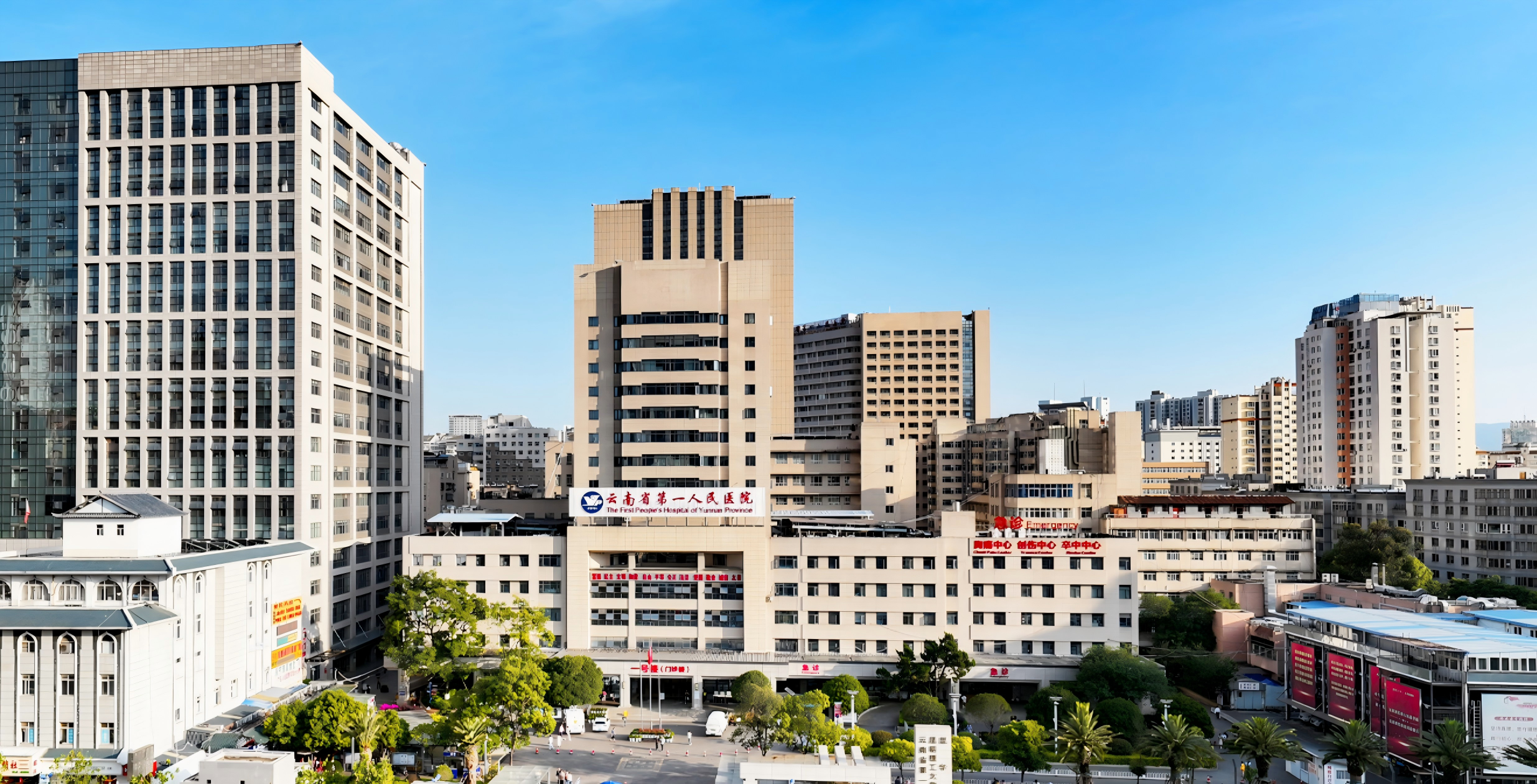
The First People's Hospital of Yunnan Province (Kunming Huazhong Hospital, Affiliated Hospital of Kunming University of Science and Technology, Yunnan Provincial Hematology Hospital) was established in 1939, adjacent to the cultural landscape and urban landmark of Kunming—the Golden Horse and Blue Rooster Archway. As the earliest self-established provincial hospital in China by Yunnan Province, it was the first to be rated as a Grade III Class A hospital in Yunnan Province in 1992 and was awarded one of the Top 100 Hospitals in China in 1999.
At the age of 80, the hospital currently operates 3,570 beds and handles over 3.1 million annual outpatient visits. It serves as a network hospital for the International Emergency Rescue Center, a member of the National Emergency Medical Rescue Team, a pilot project site for the National Flagship Hospital of Integrated Traditional Chinese and Western Medicine, a provincial-level high-quality hospital construction pilot unit, and the Yunnan Provincial Center for the Treatment of Complex and Critical Diseases. The hospital has been honored with titles such as "National Model Hospital for Leveraging Information Advantages," "National Hospital with Outstanding Quality Nursing Services," and "People's Daily Online National Model Hospital for Quality Services." It has maintained an A+ rating in the national performance evaluation indicators for tertiary public hospitals for six consecutive years. Currently, the East Campus of Yunnan Provincial First People's Hospital (National Regional Medical Center for Respiratory Diseases) is under active construction, covering an area of 238 mu (approximately 15.9 hectares) with 1,499 designated beds.
Distinctive academic discipline development is evident in the institution's current structure, which comprises 66 clinical and technical departments, including 1 National Respiratory Regional Medical Center, 11 national-level key clinical specialties, 25 provincial-level key clinical specialties, and 5 provincial-level clinical medical centers. The institution has successfully performed the world's first "super transplantation" technique for treating severe thalassemia and successfully treated a rare global case of "folding man," representing the highest level of spinal deformity correction worldwide, as reported by CCTV-4 channel. It pioneered the development of high-throughput sequencing technology for thalassemia screening and is the first institution in Yunnan Province approved for preimplantation genetic diagnosis (PGD). The institution has achieved advanced domestic and provincial levels in critical care, minimally invasive medicine, molecular biology and genetic testing technologies, comprehensive tumor therapy, cell transplantation, assisted reproductive technology, and birth defect screening and diagnosis.
Zhongling Yuxiu Medical Center currently has 4,963 employees, including 4,193 health professionals, 1,545 master's and doctoral degree holders, and 789 personnel with associate senior titles or above. Among them, 204 individuals have been selected for various national programs such as the National Hundred-Thousand-Ten Thousand Talent Program, National Outstanding Talent Program, National Special Post Program, Yunnan Province High-Level Talent Training Support Program, and Yunnan Province High-Level Talent Introduction Program. Additionally, there are 175 individuals recognized as Yunnan Province Medical Leading Talents, Medical Discipline Leaders, and Young and Middle-Aged Academic and Technical Leaders. Many have been awarded honorary titles including National Famous Doctors, National Advanced Workers, National Advanced Workers in the Health and Family Planning System, China Good Doctors, National May 1st Labor Medal, National March 8th Red Banner Bearer, National Women's Meritorious Model, and National Outstanding Nurses.
Scientific and technological innovation drives development. The institution hosts 1 National Health Commission Key Laboratory, 4 Provincial Key Laboratories, 6 Provincial Clinical Medical Research Centers, 5 Provincial Engineering Research Centers, 1 Provincial Engineering Technology Research Center, 35 Provincial Academician (Expert) Workstations, 8 Provincial Innovation Teams, and 2 International Joint Innovation Platforms (including 1 International Joint Laboratory and 1 International Joint R&D Center). It also operates 1 national and 1 provincial postdoctoral research workstation, serving as a National Stem Cell Clinical Research Registry Institution and a National Drug Clinical Trial Institution. Over the past three years, the institution has secured 883 research grants and received 22 provincial/ministerial-level scientific achievement awards, including 14 provincial awards and 8 departmental-level awards. It has published 516 SCI-indexed papers with a total impact factor of 1,887.4 and authored 28 monographs. Currently, 82 national research projects are underway (including 4 general projects and 19 youth projects). The institution's national research funding indicators have consistently exceeded the 100 million yuan threshold.
As a teaching institution serving both domestic and international students, Kunming University of Science and Technology Affiliated Hospital (Clinical Medical College of Kunming University of Science and Technology Medical Department) has established a comprehensive "undergraduate-to-postgraduate" academic education system. Through joint efforts with Kunming University of Science and Technology Medical Department, the hospital offers two undergraduate programs in Clinical Medicine and Nursing, with one first-level discipline doctoral authorization point, two first-level discipline master's authorization points, and one professional master's degree category authorization point. It has established 27 national standardized physician training bases, one professional backbone faculty training base, five county-level hospital backbone specialist physician training bases, and 15 provincial continuing education bases, undertaking theoretical and practical teaching tasks for 15 institutions including Kunming University of Science and Technology. Currently, the hospital maintains a consistently high pass rate in the comprehensive evaluation of resident physician training completion among provincial institutions and has ranked first in the annual comprehensive evaluation of resident physician training bases in Yunnan Province for three consecutive years. In 2024, it was approved for the "Yunnan Provincial Radiation Center for South Asia and Southeast Asia-Yunnan First People's Hospital Medical Technology Training Base" project, having hosted over 300 hospital administrators and medical professionals from countries including Cambodia, Laos, and Myanmar for advanced training programs.
Smart Hospital Process Optimization and Deepening Construction of Smart Hospitals: In alignment with national healthcare informatization requirements, the hospital has passed the National Health Commission's Level IV Grade A Interoperability Evaluation and achieved Level V grading assessment for electronic medical record system functionality and Level III grading evaluation for smart services. Continuous promotion of internet applications enables online provision of services including consultation, medication dispensing, examination order issuance, and hospital admission certification, facilitating the transition of offline services to digital platforms to enhance patient experience. Comprehensive implementation of in-clinic settlement and nurse station bedside settlement models has achieved an in-clinic settlement rate of 72% and a nurse station bedside settlement rate of 90%. After successful outpatient and auxiliary examination appointments, patients are reminded to reach designated locations via hospital navigation systems. Ongoing optimization of patient care processes, supported by big data analytics from informatization initiatives, includes the introduction of provincial first-of-its-kind photon CT and 5.0T MRI equipment under the National Equipment Upgrade Program. Strategic device placement based on patient needs significantly reduces examination wait times and continuously improves healthcare experience.
Medical Consortium Collaboration for Shared Success In 2014, the Kunming-Hua Medical Consortium was established as the first such entity within the province. To date, it has signed agreements with 253 medical institutions, covering 16 prefecture-level cities in Yunnan Province and adjacent counties in Guizhou and Guangxi. Over 350 expert team workstations have been established, with leadership roles in 8 provincial specialty alliances as chair units and participation in 13 other alliances as vice-chair units, involving more than 1,100 member institutions. Additionally, a "Infertility and Reproductive Health Specialty Alliance" was formed with 58 hospitals, achieving standardized management and two-way referral through technical assistance, thereby creating a shared responsibility and service framework. On average, nearly 1,000 key medical professionals from consortium member institutions participate in annual training programs at the hospital.
International aid highlights public welfare, with multiple batches of medical teams dispatched to Laos, Cambodia, Myanmar, Uganda, Sudan, and other countries to carry out the "Lighting the Way" international blindness relief public welfare activities. Successive international cooperation projects such as the "China Yunnan Provincial First People's Hospital–Laos Luang Prabang China-Laos Friendship Hospital Medical Service Cooperation Consortium Construction Project", the "International Cooperation Project on the Current Status Survey of Thalassemia in the Lancang-Mekong-Mediterranean Region", and the "ASEAN-China Cooperation Fund Healthy Breathing Road Project" have been conducted, receiving widespread acclaim.